WaveSurfer Inc. engineers proprietary subsea wave energy converters designed for grid resilience, coastal industrial power, and direct green energy for hyperscale AI data centers.
Terrestrial high-voltage transmission lines are congested, permitting takes decades, and inland land acquisition costs continue to skyrocket[cite: 1]. WaveSurfer transforms coastlines into direct, offshore clean energy interconnects[cite: 1].
Deploy directly adjacent to coastal power corridors, delivering utility-scale gigawatts via direct marine export cabling without waiting on regional grid expansions[cite: 1].
Perfect alignment for coastal hyperscale data centers, green hydrogen hubs, and high-volume seawater desalination facilities[cite: 1].
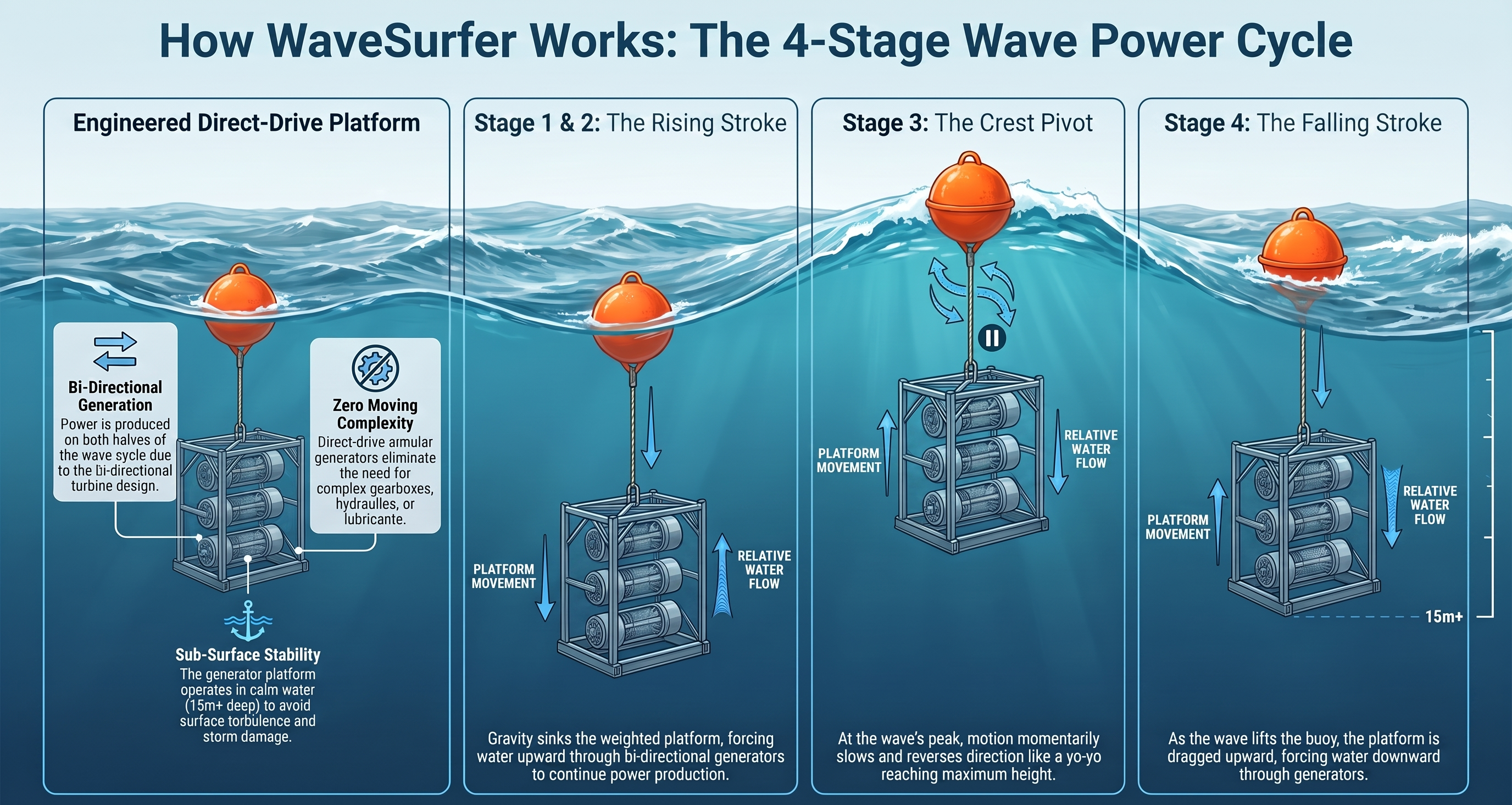
Understanding the kinetic transition: harvesting surface wave power while operating generators in the calmer deep-water zone[cite: 1].
Cross-sectional profile demonstrating active surface wave extraction paired with submerged deep-water generation[cite: 1].
Modern AI computing clusters demand constant, multi-gigawatt clean power[cite: 1]. WaveSurfer delivers dedicated ocean energy directly to shore, bypassing congested terrestrial grids while offering seawater cooling synergies[cite: 1].
Predictable, continuous wave action delivers power day and night without solar or wind dropouts[cite: 1].
Offshore infrastructure co-locates deep cold water intake for direct data center heat exchangers[cite: 1].
Eliminate reliance on fossil peaker plants or carbon credit purchases with direct clean power[cite: 1].
Significantly reduces massive battery storage banks needed by intermittent renewables[cite: 1].
*Calculated at 0.7 MT CO2/MWh average grid displacement baseline.
Comprehensive strategic architecture detailing direct subsea transmission, continuous baseload harvest corridors, and multi-gigawatt scalability for coastal AI clusters[cite: 1].
Continuous bi-directional power capture throughout the full cycle of the wave passage[cite: 1].
Operational validation, survival engineering, and transmission infrastructure for utility-scale deployment[cite: 1].
Sealed hydrodynamic power train operating across calibrated ocean depth gradients for optimal pressure differential capture[cite: 1].
Subsea pitch-feathering and adaptive hydrostatic ballasting safeguard mechanical integrity during extreme 100-year storm seas[cite: 1].
Targeting continuous global maritime zones with annual wave power densities delivering reliable baseload electricity to AI hubs[cite: 1].
Engineered for multi-unit offshore wave farms, delivering high-voltage direct power to onshore facilities and coastal infrastructure[cite: 1].
Explore technical deep-dives on clean computing power, subsea generator separation, and marine energy systems[cite: 1].
The AI boom is running out of power and water—and the ocean is the ultimate fix. Here’s how wave energy delivers the 24/7 clean baseload needed to fuel the future of compute.
An in-depth audio examination detailing how continuous subsea wave energy conversion solves the multi-gigawatt baseload power constraint facing next-generation hyperscale AI clusters[cite: 1].
Discover how ocean wave energy could solve the AI industry's looming power and cooling crunch. Watch to see how WaveSurfer turns continuous ocean swells into clean, 24/7 baseload electricity for next-generation coastal data centers—and explore the planned pilot project in Oregon.
Can the ocean solve AI's massive power and cooling crisis? Watch to see how WaveSurfer harnesses continuous ocean waves to deliver 24/7 clean baseload electricity to coastal hyperscale data centers and for cold seawater cooling.
How do we power the AI revolution without breaking the grid? Watch to see how WaveSurfer solves the wave-energy durability bottleneck by moving generators into calm deep water, unlocking 24/7 baseload renewable electricity for coastal hyperscale data centers.
Tracking the latest developments in ocean baseload power and clean computing infrastructure[cite: 1].
Surging AI workload power demands are shifting infrastructure investments to coastal ocean energy hubs to bypass congested regional utility grids[cite: 1].
New industrial benchmark analyses indicate subsea wave energy arrays achieving $0.045-$0.085/kWh delivered cost, outcompeting offshore wind and BESS-backed solar for 24/7 baseload[cite: 1].
Multi-year marine biodiversity monitoring confirms zero acoustic disruption and measurable enhancement of benthic fish populations[cite: 1].
For all technical proposals, utility-scale developments, and commercial discussions, please direct your communication directly to our core engineering and operations desk[cite: 1]: